This is the 12th station I have visited on the Central Line. Hainault is one of the stations on the loop.


 The tube was empty today so I thought I would show you the inside. This is one of the newer trains and it doesn't have separate carriages so you can see how empty the train is. It takes about 40 minutes to travel from the centre of London to Hainault.
 The station was opened in May 1903 as part of the Woodford to Ilford loop or branch line. Due to lack of custom it closed in October 1908 and didn't reopen until March 1930. During the 1935-40 'New Works programme' the majority of the loop was to be transferred to the Central Line to form its eastern extension. Work on this was suspended due to the outbreak of the war and didn't start again until 1946.
 Alterations to the station included this island platform which allowed services via Gants Hill to be terminated here as well as allowing access to Hainault depot. The building was completed in 1939 but was only used by the US Army Transportation Corps until 1945.
 The Hainault depot is situated to the North of the station and is the major depot on the eastern end of the line. It was in use for the Central line from 1947.

 You exit the platform via these steps. However in 2009 lifts were installed to give step-free access to the station.
 You exit the station onto a very straight road, the New North Road.

In fact one of the straightest roads I have seen in the UK. There are houses on either side of the road punctuated now and again by a few shops.
 All the houses I saw had been built from the 1930s onwards. I decided to find the local library for more information.
 I continued walking along the New North road passed these allotments. You will find allotments in every town and city in the UK. It is a small area of land divided up into small sections which are leased to people in the local community to give them space to grow their own vegetables/flowers. They are becoming increasingly popular and there is often a waiting list to obtain one.

 Passed the local fire station and walked on until I came to Staggart Green where I found the local library.

Fortunately it was open and I couldn't wait to get inside as it had begun to pour down with rain.

Although it is a small library it did have a few books on local history. I discovered that unlike many of the other villages and small towns I have visited, Hainault has no historic centre. There are no surviving buildings that are older than the railway station. The name was recorded as Henehout in 1221 and thought to be Anglo Saxon as the words Higna Holt mean 'monastic community wood'.
The straight road (New North Road) that I mentioned earlier was cut as a logging track for removing timber from Hainault Forest. In 1851 on each side of the track a parallel line was drawn one eighth of a mile from the track and the landwas divided up into small sections to compensate people for losing grazing rights. The arrival of the railway in 1903 was supposed to stimulate house building but nothing happened until 1930 when landowners sold off their land for development and by 1939 houses were being built along the New North road.
 Just outside the library is the war memorial.

Down the road from the library was this block of flats which stood out with the Mondrian influenced corner windows.
 On the other side of Stuggart Green was yet another small row of shops but I was now ready for a 'cuppa'.
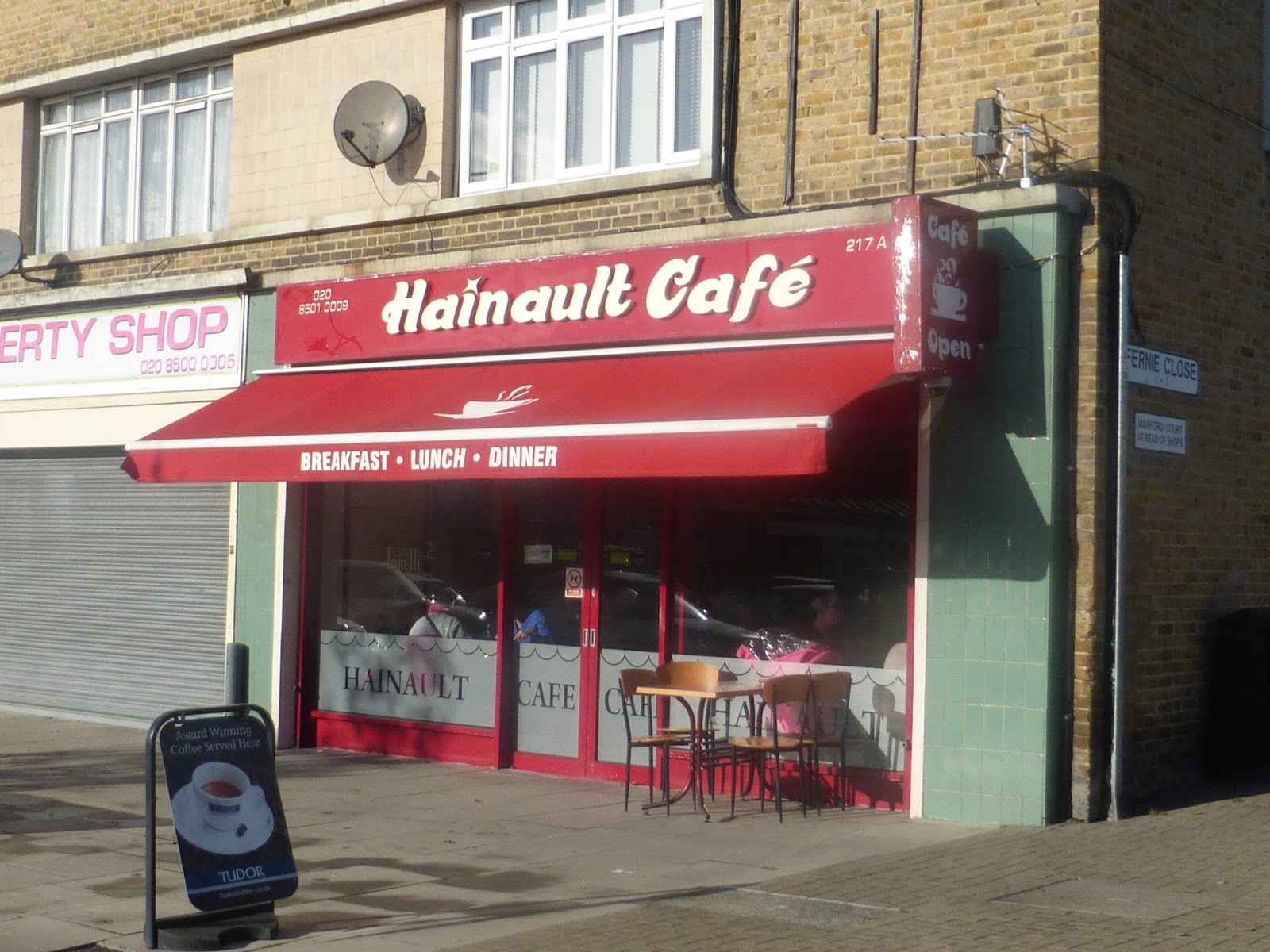
 So I had lunch in a 'greasy spoon'. No upmarket delis here, but they served a good cup of tea and bacon roll. Looking around at my fellow diners, there was a table of young mums with their babies, a couple of tables with pensioners and the rest were labourers on their lunch break. I could only hear English being spoken which is very unusual in London these days.

After lunch my walk led to the Gardens of Peace, a Muslim cemetery.
 It was very tranquil inside and different from other cemeteries I have seen.

 The graves were uniformly laid out with just a simple inscription engraved onto a metal plaque. The graves were covered with sedum mats.


Luckily for me the rain didn't come my way.
 I continued to the end of New North Road and found Hainault Country Park.

 What a delightful way to end my search of the area around Hainault station.


In fact one of the straightest roads I have seen in the UK. There are houses on either side of the road punctuated now and again by a few shops.


Fortunately it was open and I couldn't wait to get inside as it had begun to pour down with rain.

Although it is a small library it did have a few books on local history. I discovered that unlike many of the other villages and small towns I have visited, Hainault has no historic centre. There are no surviving buildings that are older than the railway station. The name was recorded as Henehout in 1221 and thought to be Anglo Saxon as the words Higna Holt mean 'monastic community wood'.
The straight road (New North Road) that I mentioned earlier was cut as a logging track for removing timber from Hainault Forest. In 1851 on each side of the track a parallel line was drawn one eighth of a mile from the track and the landwas divided up into small sections to compensate people for losing grazing rights. The arrival of the railway in 1903 was supposed to stimulate house building but nothing happened until 1930 when landowners sold off their land for development and by 1939 houses were being built along the New North road.


Down the road from the library was this block of flats which stood out with the Mondrian influenced corner windows.


After lunch my walk led to the Gardens of Peace, a Muslim cemetery.


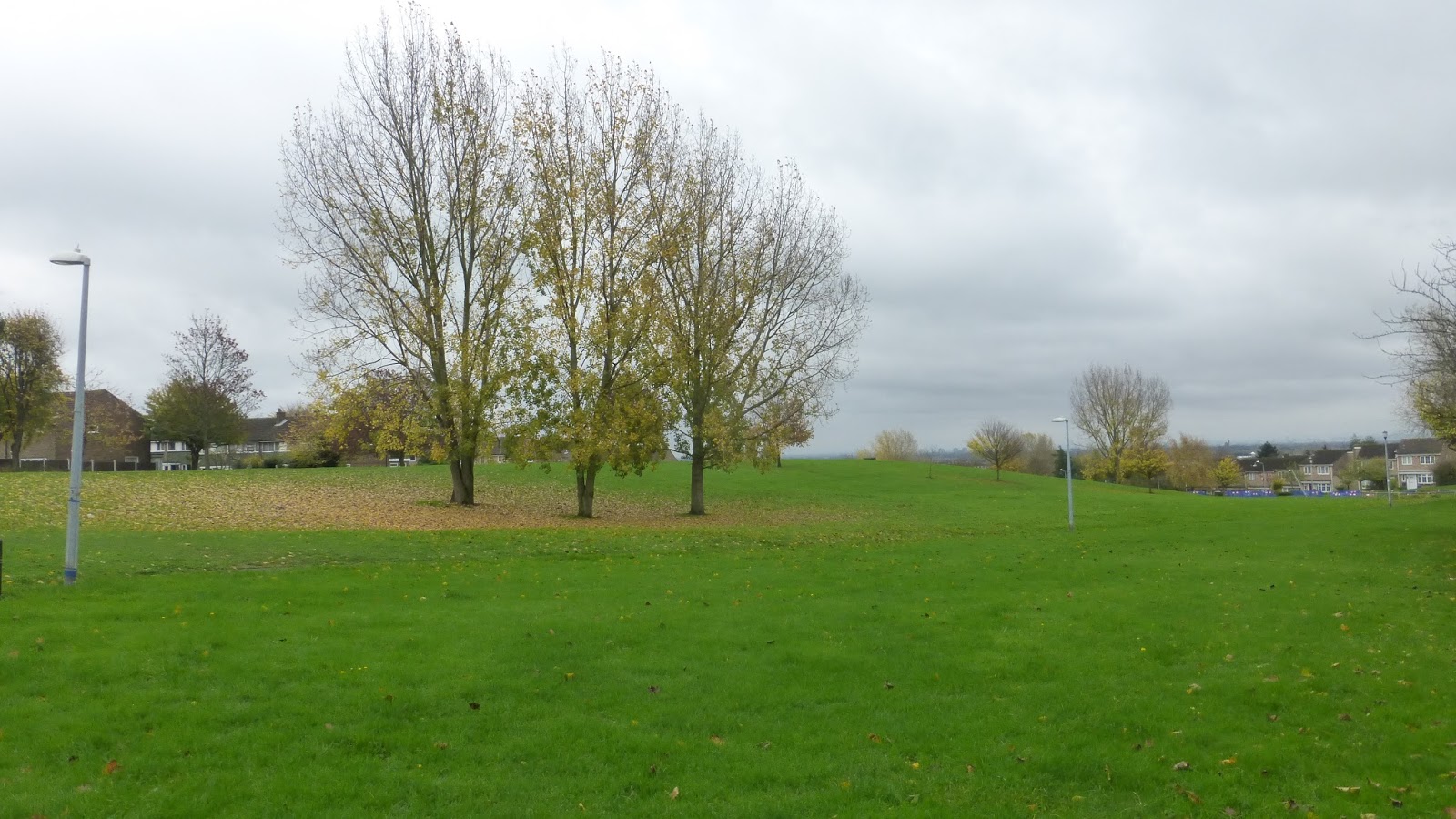
I had now left the housing development behind and had found some open space. Across the road from theGardens of Peace was Hainault recreation ground.

Bright sunshine in one direction but look at the clouds in the opposite direction.

Luckily for me the rain didn't come my way.