This is the second station that I have visited on the Central Line.


The present bridge going over the lines was built in 1885 in Glasgow.

 On leaving the station it takes just a minute to walk into the small rural village.

The origin of the name comes from the family of Bois (de Bosco) which owned the manor in the 12th and 13th cent. The name Bois is pronounced boyce.
 This is the centre of the village. It was a Sunday when I visited so most of the shops were closed which was a pity as they looked very inviting.


There are two pubs in the village. The Bull dates back to the 17th Century. It remained a residential house until 1717 because the village was too small with too few visitors.

The second pub is the Queen Victoria. It has been a McMullen pub since 1898.


This modern building is the village hall used for many purposes such as meetings of the Women's Institute and the U3A plus art classees, keep fit etc. Seems to be the centre of village activities.
Across the road is the large village green


 The village is bordered by the Essex countryside and Epping Forest.
 .
.
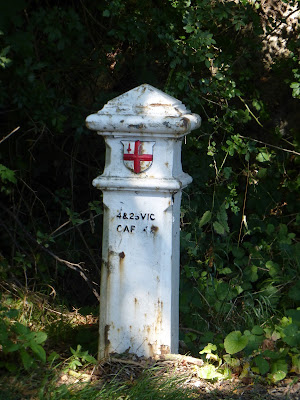
This is a coal tax post denoting the boundary whereby taxes on coal were due to the Corporation of London. Coal imported into the City of London has been taxed since Medieval times. The collection of these duties was abolished in 1889 but a number of these posts still remain.
 I thought there might be a way into the forest along this road but as the sign mentions, this area of the Forest is a deer sanctuary. Returning back towards the village I passed this large building which is
 the telephone exchange. I assume it covers a much larger area than just the village.

The parish church of St Mary the Virgin built in 1850. It is a beautiful little church with a charming churchyard.


 Here I met C(more info here) who showed me the entrance into the Forest via a narrow path from the churchyard. He then acted as my guide for the next few hours.


 The land between the Forest and the countryside beyond is known as the Buffer Land. It is still accessible to the public but there are certain restrictions such as keeping your dog on a leash. On this land is Copped Hall Park which was a medieval hunting ground.

The ruined mansion is owned by the Copped Hall Trust and is being actively restored following the fire that destroyed it in 1917.


This is the view from the mansion.

I returned to the station via one of the main paths through the Forest.

 Fields and open countryside occupy the land on the opposite side of the station from the village.

As I waited for the tube train to arrive I reflected on the location of this underground station in the heart of Epping Forest and the surrounding beautiful Essex countryside. Not sure I will find another station in such a beautiful setting.


The station began its life as Theydon in 1865 on the Great Eastern Railway and became part of the London Underground in 1949


The present bridge going over the lines was built in 1885 in Glasgow.


The origin of the name comes from the family of Bois (de Bosco) which owned the manor in the 12th and 13th cent. The name Bois is pronounced boyce.


There are two pubs in the village. The Bull dates back to the 17th Century. It remained a residential house until 1717 because the village was too small with too few visitors.

The second pub is the Queen Victoria. It has been a McMullen pub since 1898.


This modern building is the village hall used for many purposes such as meetings of the Women's Institute and the U3A plus art classees, keep fit etc. Seems to be the centre of village activities.


 .
.This is a coal tax post denoting the boundary whereby taxes on coal were due to the Corporation of London. Coal imported into the City of London has been taxed since Medieval times. The collection of these duties was abolished in 1889 but a number of these posts still remain.


The parish church of St Mary the Virgin built in 1850. It is a beautiful little church with a charming churchyard.


This is the view from the mansion.

I returned to the station via one of the main paths through the Forest.


