Saturday, January 10, 2015

Lambeth North

The second station on the Bakerloo line when travelling North. A deep level station at 70 feet below street level. Access to street level is by lift or by climbing an 84 step spiral staircase.


The station is at the junction of Westminster Bridge Road and Baylis Road. When it first opened it was called Kennington Road but after a few months it became Westminster Bridge Road station. Then in 1917 it was changed to its current name of Lambeth North.


Across the road is the Oasis Church Waterloo offering a range of services providing all aspects of support for the surrounding  community.


Continuing down St George's Road you come to St George's RC Cathedral. It doesn't look particularly impressive from the outside but the inside is magnificent.


Walking in the opposite direction along Westminster Bridge Road, brings you out on Lambeth Palace Road.  This is the site of St Thomas's Hospital. The hospital moved here in 1862 from Southwark where it had provided treatment and shelter for the poor since at least the 12th cent.

In 1859 Florence Nightingale began her nursing school at the hospital. There is a museum dedicated to Florence Nightingale in the grounds of the hospital.


On the opposite side of the road to the hospital is Archbishop's Park. The park was originally part of Lambeth Palace, the London home of the Archbishop of Canterbury. In 1901 nine acres of land from the Archbishop's garden was given to the people of Lambeth on an indefinite lease


This is Morton's Tower built in 1490 and is the entrance into Lambeth Palace which is still used as the London home of  the Archbishop of Canterbury, the leader of the Church of England.


Around the corner from the Palace on Lambeth Road is a deconsecrated church which is now The Garden Museum more info here


On Westminster Bridge Road just a few minutes walk from Lambeth North station is one of the strangest railway stations I have ever come across. At No 121 is the remains of the entrance to what used to be  London Necropolis Station. The sole purpose of this station was to transport dead bodies and their funeral parties to Brookwood Cemetery. This cemetery was once the largest in the world and was built to cope with the overcrowding of the London burial grounds. This began in 1854 and continued into the 1930s by which time other cemeteries in London were built. When bodies arrived at Brookwood there were two exits -  a South station for the Anglicans and a North station for any others. In 1941 bombing destroyed the line and the Necropolis Railway line was closed.


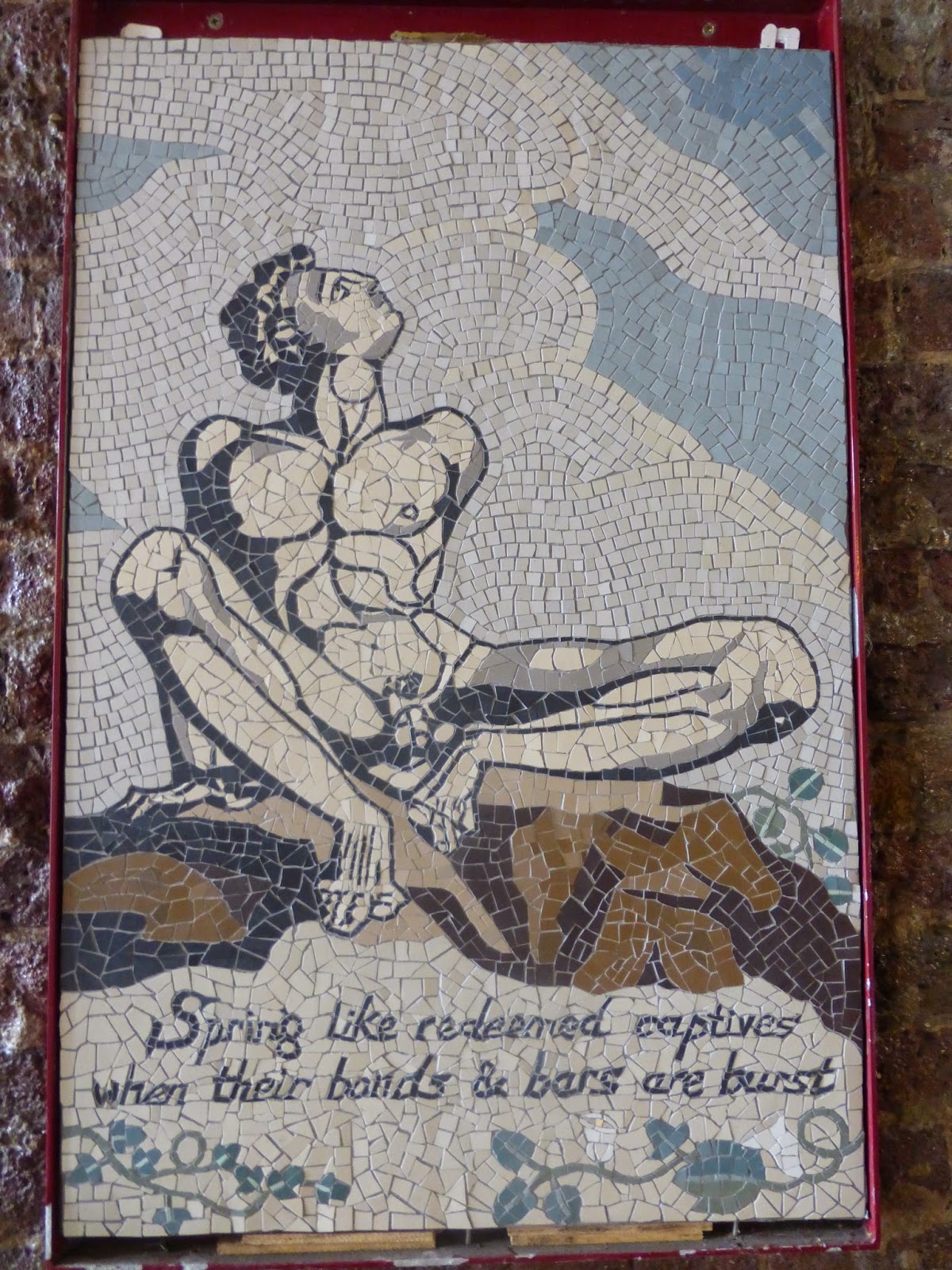
Walking along Hercules Road away from Lambeth North you will pass the site  where William Blake, the poet and artist, lived. Looking out on the right there is a short tunnel going beneath the railway lines and lining the walls are some mosaics describing extracts  from Blake's poems.


Turning left onto Lambeth Road and then right you arrive at Lambeth Walk made famous from the music hall song and dance featured in the musical Me and my Girl. The Lambeth Walk became a dance craze in the 30s and 40s

Anytime you're Lambeth way
Any evening, any day,
You'll find us all doin' the Lambeth walk.

The first building you see was built in the art deco style during the 1950s. It was the Lambeth public laundry and slipper baths before becoming  a health centre. The large doors on either side were the entrances into the baths. In the 50s very few houses had bathrooms or facilities for washing clothes so most local councils provided bath houses.


Continuing down Lambeth Walk this building cannot escape notice. Built in 1910, Pelham Mission Hall is now the sculpture studio of Morley College. If you look closely you will see its distinctive outdoor pulpit.


Looking at this corner building I noticed a stone with an inscription. With close inspection I read this unusual declaration.


Turning right onto Old Paradise Street  I walked to the end and entered the Old Paradise Gardens. The site was used as a burial ground between 1703 and 1853. Many of the old gravestones line the walls and it's still possible to see these cigar shaped tombs embedded in the grass.


This stone marks the spot of the 1825 Watch House where the parish's drunk and disorderly were locked up until they were sober enough to leave.
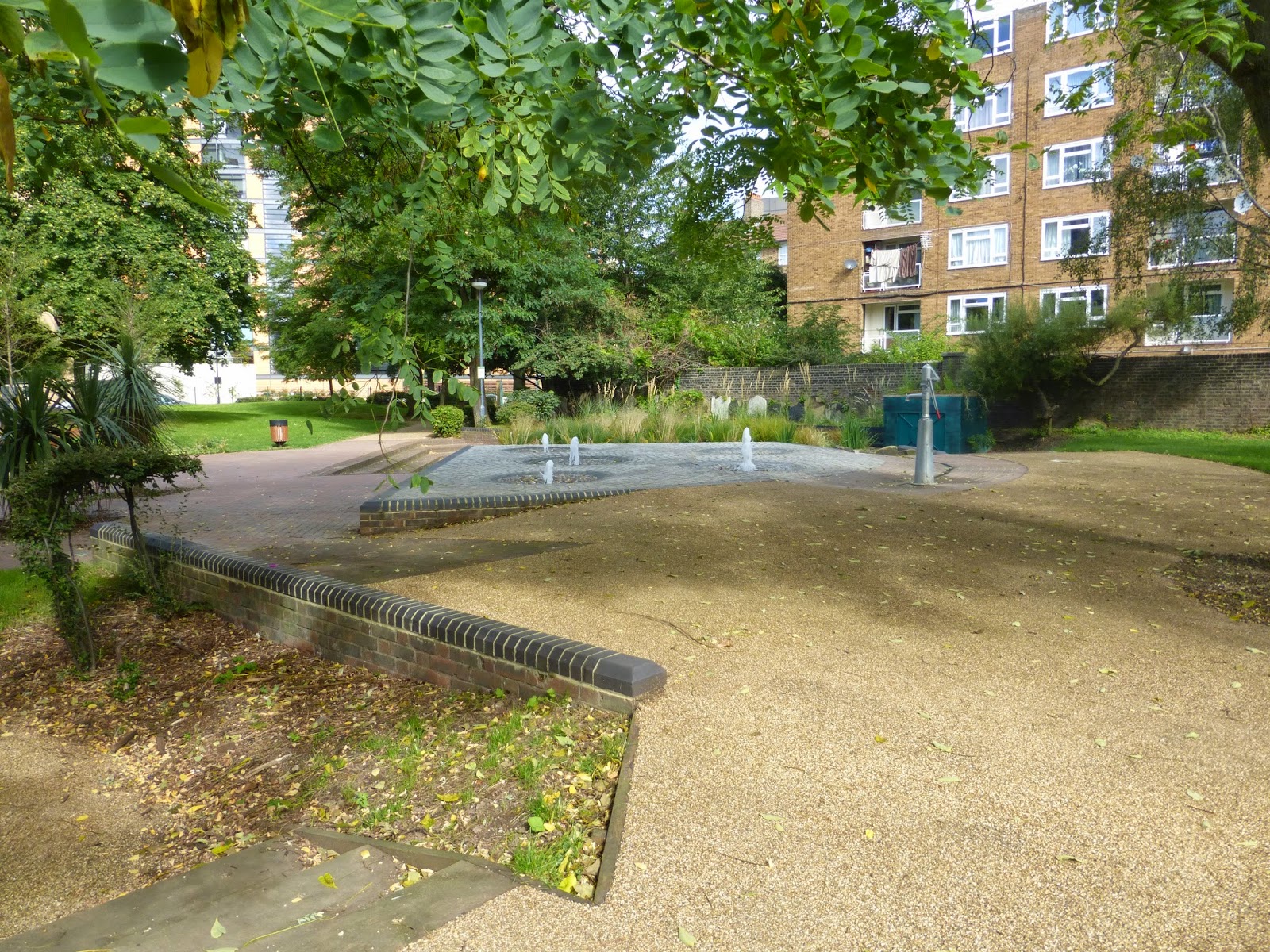


Since the 1970s the park has been landscaped with new shrubs, plants and a playground and fountains.


The name of this Victorian  pub - The Windmill is a reminder of the days when there were 3 windmills in this area.
Walking further down Lambeth High Street and you see such a mixture of architecture from different periods of history. The building that stands out is the old showroom of the Royal Doulton  Pottery Company.


The building is covered with terracotta tiles of various designs. The offices eventually moved to Staffordshire to be close to the factory where the pottery was produced.


Further down Black Prince Road turn into Newport Street to see this building which used to be Beaufoy's Ragged School. Ragged schools provided an education for the poor. They were open on Sundays as many children worked on the other days of the week.  By the late Victorian period there were several hundred of these schools around England until the Education Act of 1870 provided free state education so these schools were either run by the State or closed. This school was sponsored by the Beaufoy family and is said to have held 1000 children.


Sharing with Our World Tuesday

Sunday, January 4, 2015

Elephant and Castle

This is the first of my posts about 'Above the Underground' I am starting with the Bakerloo Line which travels from the Elephant & Castle in South East London to Harrow & Wealdstone in North West London. 

Geographically accurate path of the Bakerloo line

( Wikipedia)

The Bakerloo line has 25 stations of which 15 are at a deep level underground. The name comes from the amalgamation of the words Baker and Waterloo which are stations on this line and it is the brown coloured line on the tube map. It carries over 110 million passengers per year.
The first station on the line going from South to North is The Elephant & Castle and to reach the street level you need to either take a lift or climb the steep, spiral staircase as there are no escalators at this station. The building above the station is used by London Underground for administration.


You emerge from the station onto a huge roundabout. Subways take you from one side to the other with 5 different exits. Lots of people prefer to cross the road rather than descending to the dark subways not knowing who you might meet.

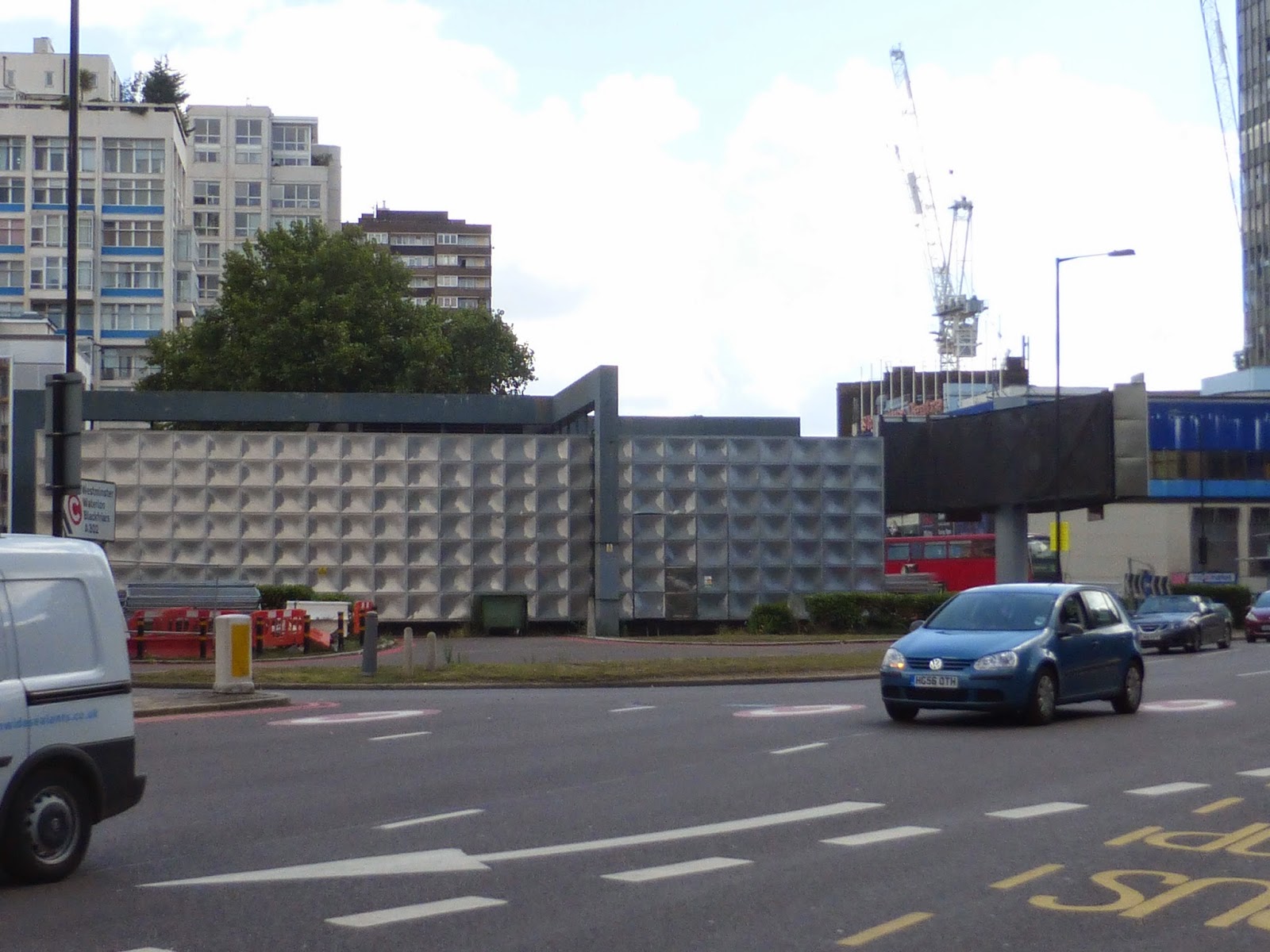
The structure in the centre of the roundabout is a memorial to the scientist Michael Faraday (born nearby in 1791) which lights up during the hours of darkness. The box shaped structure hides the electrical substation for the Underground.

Diagonally opposite the Underground station is the shopping centre, a dismal place but should soon undergo a major refurbishment. Much of the surrounding area has changed under a regeneration program. The 60s built concrete flats have nearly all been demolished with the promise of new apartments taking their place.


Opposite the shopping centre is the Metropolitan Tabernacle church. It is an independent Baptist church built in the late 19th C. Although the outside is a wonderful classical piece of architecture that isn't the case inside which was destroyed by fire in the 1890s and again during WW2 and was last rebuilt in the 1950s.


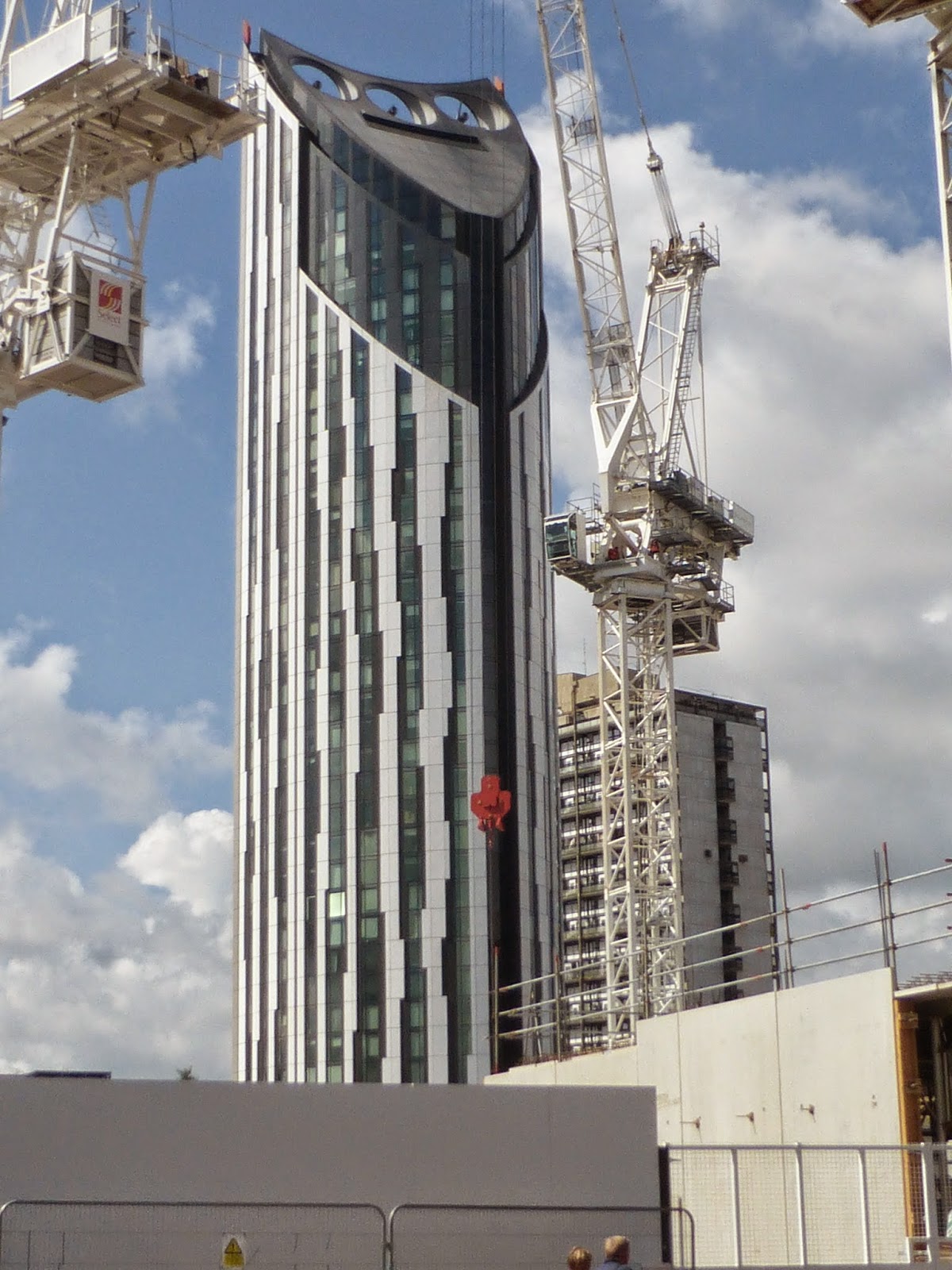
Walking past the shopping centre and down Walworth road you see a familiar building from the London skyline. It is the Strata building with its distinctive three wind turbines built into the top of the building. It is a residential tower block of 43 floors.


(Aug 2014)

Continuing along the Walworth road you pass the old Walworth town hall which housed the Cuming Museum. Unfortunately a fire in March 2013 meant that it had to close whilst repairs were carried out. It is hoped that the Museum will reopen in the not too distant future.

A couple of minutes walk from the Museum is East Street Market. This market is one of the oldest in London and has officially been running since 1880. However there has been street trading going on in Walworth since the 16thC


On the corner of East Street and Walworth Road is a blue plaque commemorating the silent movie comic, Charlie Chaplin who was born in Walworth.


These are the railway arches beneath the main rail line which are used as shops and restaurants.
This is St Mary's Churchyard on Newington Butts which reopened as a park in 2008. A new leisure centre is currently being built alongside the park.


Behind the Tabernacle Church on St George's Street is the University of the Arts


There are a number of these tiny parks around London. They are full of greenery and always have seats. They are part of the Mayor's idea to provide as many green places as possible for people to get away from the hustle and bustle of the city and relax in a green haven.

West Square just off St George's Road built in the late 18th C. The houses are four storied buildings. Charlie Chaplin lived here briefly as a boy and now being close to Westminster it is home to a number of politicians.


Further along St George's Road is Geraldine Mary Harmsworth Park which leads you to the Tibetan Peace Garden

and on to The Imperial War Museum. This building was originally 'Bethlem Royal Hospital' a hospital for people with mental illnesses informally known as Bedlam. The meaning of the word bedlam (a scene of uproar and confusion) is derived from the hospital's nickname. The hospital moved to West Wickham in the Borough of Bromley in 1930 and the Imperial War Museum moved here in 1936.


The first baby born on the Underground was in 1924 on the Bakerloo line at the Elephant & Castle.