Monday, February 9, 2015

Piccadilly Circus

This post  is part of my series 'Above the Underground'. I am hoping to visit, photograph and research every station on the London Underground. 
This station is No. 6 on the Bakerloo line going North. Both the Bakerloo and the Piccadilly line stop here.

The underground station is directly below Piccadilly Circus with no building above ground and has 4 exits/entrances. The name Piccadilly comes from a 17th Cent frilled collar called a piccadil which were made in this area and the word 'circus' comes from the Latin word meaning 'circle'


In the centre of Piccadilly Circus is possibly the most famous meeting place in London. This is the Shaftesbury Memorial fountain, commonly known as the statue of Eros. However the statue was originally called the Angel of Christian Charity but was renamed Eros after the Greek god of love.


The Circus is at the centre of five main roads: Regent Street, Shaftesbury Avenue, Piccadilly, Coventry Street and Haymarket.


London's first illuminated billboard was installed here in 1895.

The Trocodero is a large building on Coventry Street. Built in 1896 as a restaurant, it closed in 1965. It was almost 20 years later before it reopened as an entertainment area with a variety of rides and exhibitions. It is currently changing its usage yet again as it is being redeveloped as a hotel.


The  Criterion Building, which occupies the whole of the South side of Piccadilly Circus is home to the Criterion restaurant, theatre and Lillywhites. at the corner of the building is the sculpture of the Horses of Helios that you see so many people photograph


yet so few look up to see the three Daughters of Helios (the Three Graces) leaping from the top of the building. Both sculptures are by Rudy Weller.


At the other end of the Criterion building is this large sports shop, once a great sporting institution. Although this store only opened in 1925, Lillywhites was a family run business since 1877. William Lillywhite introduced overarm bowling to cricket and his son, James, was the first ever captain of an England team against Australia in 1877. The bronze plaque above shows James playing in a bowler hat. Entering the store now you can still see the original old oak panelled staircase. It used to be the most famous of all sports shops with no sport unrepresented but now it is the same as any other chain store selling sports wear.

Piccadilly


A gas lamp still in use on  Eagle Place just off Piccadilly.


Cordings men's outfitters specialising in outdoor and waterproof garments. In 1877 the business transferred from The Strand to Piccadilly. The company developed rubberised raincoats which were considered essential wear for those who went hunting or drove open top cars. In 2003 the company decided to ask one of its best customers if they wished to back a management buyout, which he did. That customer was Eric Clapton.


This apartment block which is set back off Piccadilly was built in the 1770s and has housed many famous residents including Prince Frederick, Duke of York; Lord Byron, William Gladstone, Aldous Huxley. Not just anyone can live here, you need to be someone with social connections in order to rent an apartment .


Entrance to Burlington House.


Burlington house, built in 1664, is the only surviving town mansion on Piccadilly built after the restoration. In 1867 it became the home of the Royal Academy, alongside the Geological, Chemical, Astronomical and Linnean societies. The courtyard is a public space used as an entrance to the various societies and also houses permanent and temporary sculptures and displays. 
The Linnean Society is the world's oldest active biological society. It was here in 1858 that Darwin first read his paper on evolution.


In the entrance to Burlington House is the first ever red phone box which is made of wood.
Burlington Arcade, Britain's first ever shopping arcade opened in 1819 and was said to have been built to stop passers by throwing oyster shells into Burlington House. Nowadays it has its own private police force of Beadles who enforce such laws as no running, whistling or opening umbrellas.
On the opposite side of the road is the department store of Fortnum and Mason. It was founded in 1707 and is a unique upmarket store. On the front of the building is the clock which chimes every 15mins, but you need to be there on the hour to see Mr Fortnum and Mr Mason appear.


St James's Church, Piccadilly. Designed by Sir Christopher Wren and the one he regarded as his best parish church. It was consecrated in 1684 and is known for its rare outdoor pulpit.


 Inside the church is the Adam and Eve baptismal font where William Blake was christened in 1757. The marble font was placed in the church in 1686 and is said to be the work of Grinling Gibbons.
The church prides itself on being an open, welcoming Christian community and does much to help the disadvantaged within the area.


At the front of the church are these magnificent wrought iron gates and railings which were erected to commemorate the coronation of Queen Elizabeth II in 1953.


Hatchard's Bookstore is the oldest bookstore in the UK. Founded in 1797 by John Hatchard in Piccadilly from where it still trades.


This was home to the Royal Institute of painters in water colours until it moved to the Mall Galleries near Trafalgar Square in 1970


Germyn Street

In 1661 Henry Germyn developed a residential area beginning with St James's Square  and its 14 grand houses


Development continued after his death and centred around the Square and St James's Church. After 300 years the area still maintains some exclusive shops concentrating on men's fashion.


This is a statue of Beau Brummel on Germyn Street. He is credited with introducing the modern men's suit, worn with a necktie. It was claimed that he took 5 hours a day to dress and his style was referred to as 'dandyism'.


This small 70 seat theatre was once the changing rooms for the staff of the restaurant upstairs. It became a theatre in 1994.


Regent Street
One of the major shopping streets in the West end of London. It is named after the Prince Regent who later became George IV. Originally designed by John Nash the layout remains but the buildings have since been replaced. Every building in Regent Street is protected as a listed building with at least Grade II status. 


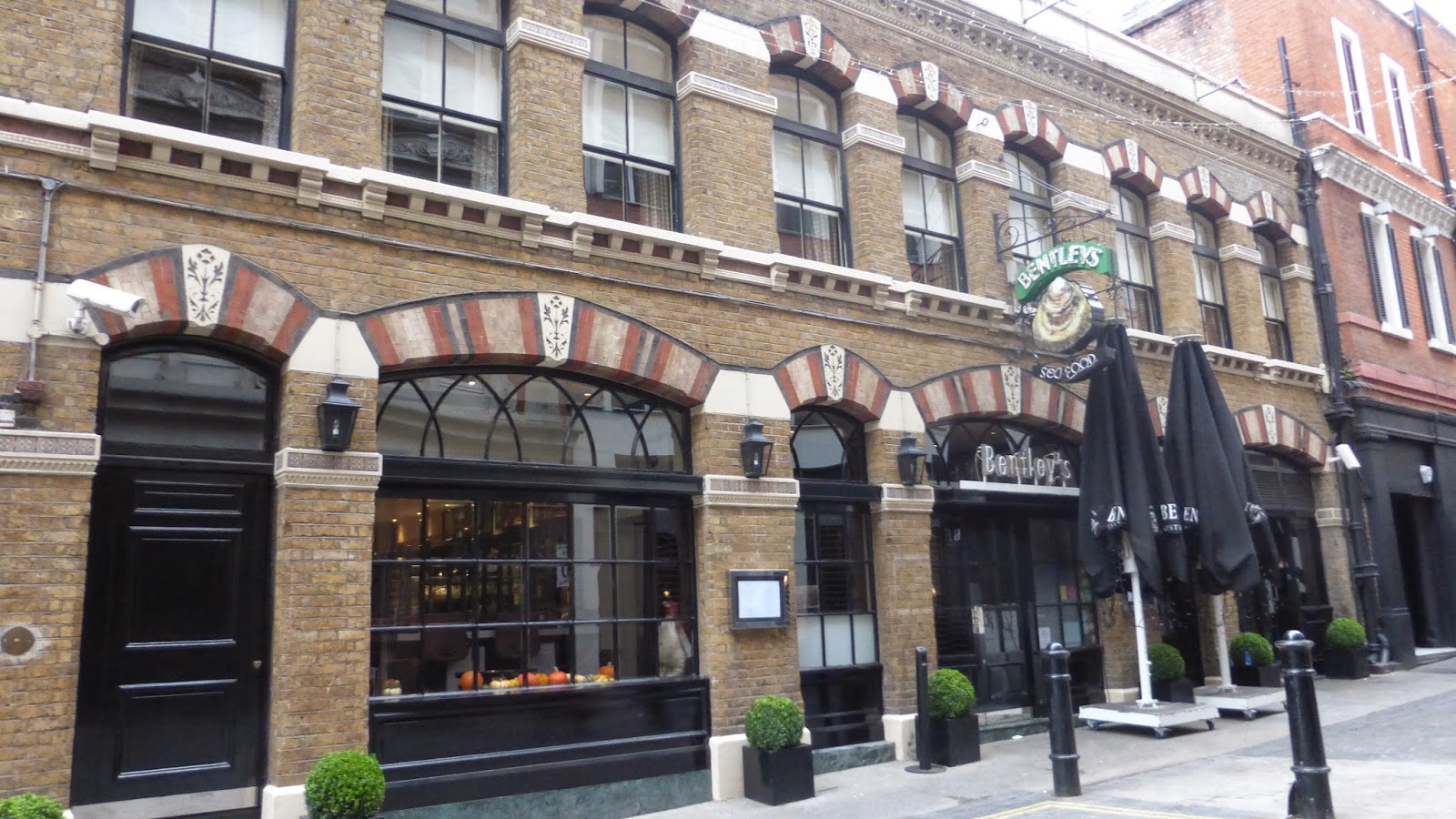
Established in 1916 Bentley's oyster bar and grill is on Swallow Street between Piccadilly and Regent Street.


Shaftesbury Avenue with some of its many theatres.


You don't have to wander far in this area to find a theatre with Her Majesty's theatre and the Theatre Royal on Haymarket .


But behind the theatres, shops and crowds you are never too far away from a green area. This is Golden Square a short walk from Regent Street.


Amazing that all of this and more is within a 5 minute walk of Piccadilly Circus tube station. Another bit of trivia about the Underground is that an estimated half a million mice live within the system.
Sharing with Our World Tuesday


Wednesday, February 4, 2015

Charing Cross

Charing Cross is the 5th stop on the Bakerloo line when travelling North. It actually takes less than a minute to travel from the previous station, Embankment to Charing Cross.


One of only three underground stations that gives other information on the roundel as well as the name.
Alighting from the tube you are treated to images from paintings in the National Gallery in Trafalgar square.


There are two lines using this station - Bakerloo and Northern with 10 exits/entrances to the station located around The Strand or Trafalgar Square.


I emerged from the exit into Trafalgar Square to see Nelson's Column towering above me.


It is said that Nelson is checking his fleet as he looks down the Mall at the ships which are on top of the lamp posts.


Guarding Nelson's Column are four bronze lions designed by Sir Edwin Landseer. In the background is The National Gallery, one of the greatest art galleries in the world.


There are also two fountains in the Square, a favourite place for jumping into on New Year's Eve. A practice which no longer happens as they are usually fenced off during the festivities. Another change in the Square is the lack of pigeons as it is now against the law to feed them. They also have a Harris Hawk to keep them away and more to the point the Square is more or less free of pigeon dropping making it the ideal space to hold public events.

The fourth plinth.
It was originally intended for an equestrian statue of William IV but lack of finance has meant it was empty for many years. It is now used for specially commissioned  pieces of art.


On one of the corners of Trafalgar Square is this old police station. Used in the past to watch the behaviour of crowds in the Square, it is now used for storing cleaning equipment.


At the back of Trafalgar Square is a plaque showing the standard imperial measurements of length. The Board of Trade installed the measures of an inch, a foot and a yard in 1876.


To the right of the Square is St Martin in the Fields which has regular free lunchtime concerts.


Downstairs in the crypt is a cafe and memorials and headstones dating back to the 1600s.

Henry Croft was the original Pearly King, a traditional that continues today. Each London Borough has their own Pearly King and Queen whose purpose is to raise money fro local charities.
Across the road from St Martin's in the Field is
The National Portrait Gallery


At the back of the church in a passageway leading back to Charing cross station is this tribute to Oscar Wilde. 


Leaving Trafalgar Square, walk through Admiralty Arch and onto the Mall.


From Admiralty Arch you look down the Mall towards Buckingham Palace. The Mall is used as a ceremonial route for members of the Royal family and guests.


A building on the Mall that many walk past without noticing is the Admiralty Citadel. Covered in Virginia creeper it is a windowless building apparently built in 1940 as a bomb proof fortress. It is not open to the public as it is still a working building today.


Close by is the National Police Memorial which contains a book with the names of all those police officers who have lost their lives whilst doing their duty.


Just off the Mall is Horseguards Parade. This where the Changing of the Guard takes place daily at 11am.


The Guardsmen are soldiers taken from one of five different regiments of Foot Guards - the Scots Guards, the Irish Guards, the Welsh Guards, the Grenadier Guards and the Coldstream Guards.


Walking through Horseguards Parade ground brings you out onto Whitehall, the home of many of the Government departments. My favourite building on Whitehall has to be the Banqueting Hall which is across the road from Horseguards. Built of brick and stone, and completed in 1609 to provide a setting for a new type of court entertainment - the masque. From the outside the Banqueting Hall doesn't look that special but once you enter the large hall and look up you will see the most magnificent ceiling painted by Peter Paul Rubens in about 1636. 


Another exit from the Charing cross tube station brings you out onto The Strand outside the main rail station at Charing Cross.


Outside the station is the Charing Cross monument. The original cross from which all distances from London were measured was located at the top of Whitehall and was demolished in 1647. The present Charing Cross Monument was built in 1863 as a meeting place for the station.


On the opposite side of the road is Coutts Bank founded in 1692 is the bank for Royalty. Every monarch since George III has had an account here. You need a minimum of £500,000 to open an account here.


There are a number of narrow alleyways off The Strand, reminders of Victorian London.


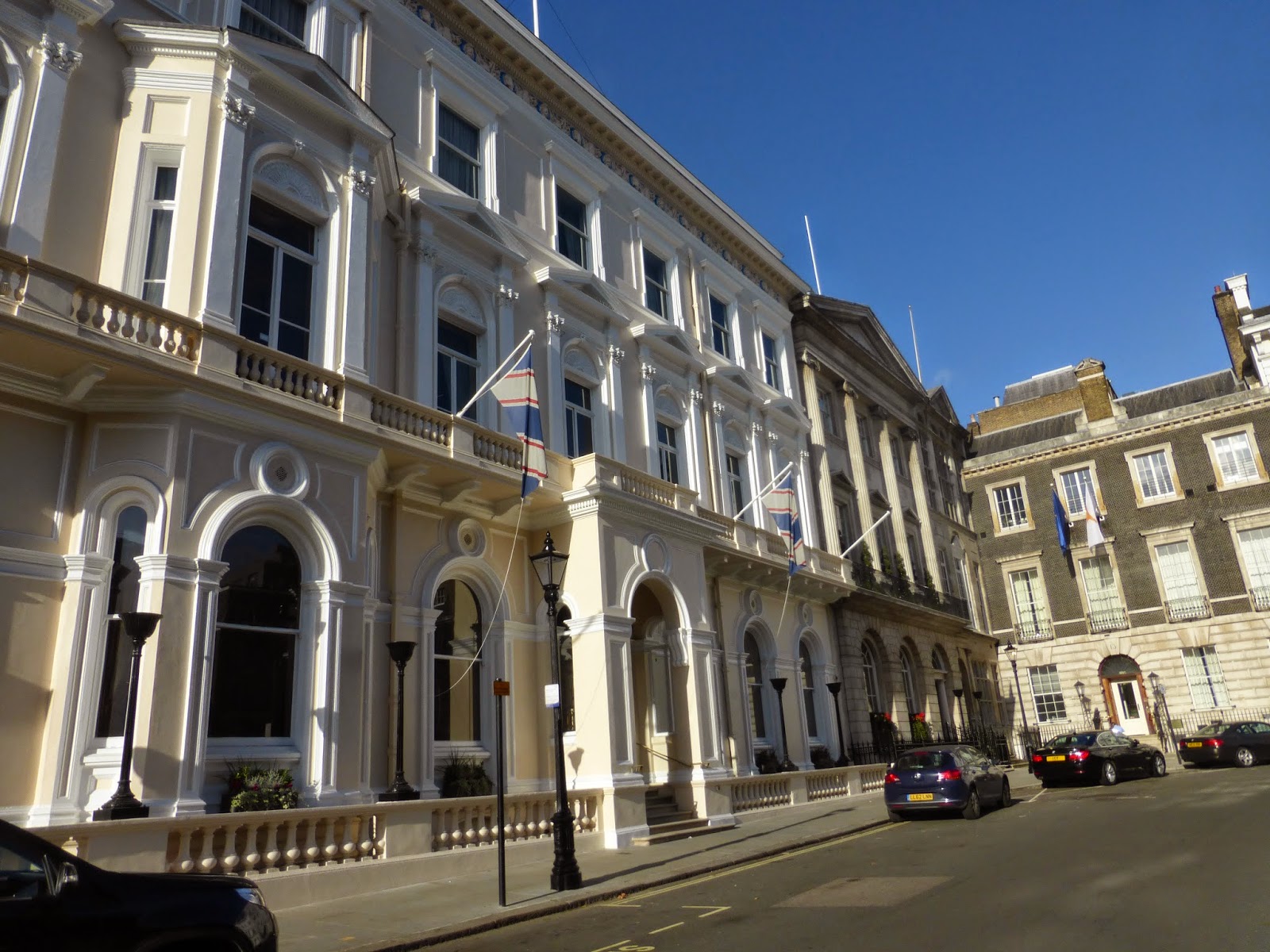
Another road leading off Trafalgar Square is  Pall Mall home to many exclusive gentlemen's clubs. Many of which do not have name plates. A gentlemen's club is a private, members only club set up in the 18th cent for the British upper middle class men. These days of course it is against the law to discriminate against women but whether you would be welcomed into some of these establishments I have no idea (nor am I ever likely to know!).


On the corner of Pall Mall and Waterloo Place is this rather grand building of the The Athenaeum club where women have been admitted since 2002. The frieze is a copy of the frieze around the Parthenon in Athens. Wikipedia describes the inside as having
.... an extensive library, a dining room known as the Coffee Room, a Morning Room, a Drawing Room on the first floor, a newly restored Smoking Room, where smoking is not permitted, and a suite of bedrooms.


Another feature of Waterloo Place is this monument to Prince Frederick,the Duke of York who was commander-in chief of the British Army during the French Revolutionary Wars and is remembered in the nursery rhyme,' The Grand Old Duke of York' . The column is very high at 42m and at the time was said he needed to be that high to avoid his creditors. The cost of the column was met by money from the Army (each soldier had to forego one day's pay!). It has a staircase leading to the top of the monument but this was closed many years ago as it became a popular place for people with suicidal thoughts.

The next station on the Bakerloo Line is a few minutes walk away from Pall mall at Piccadilly Circus.